








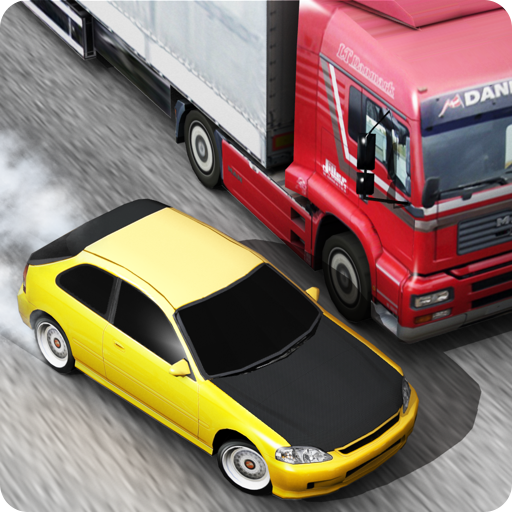
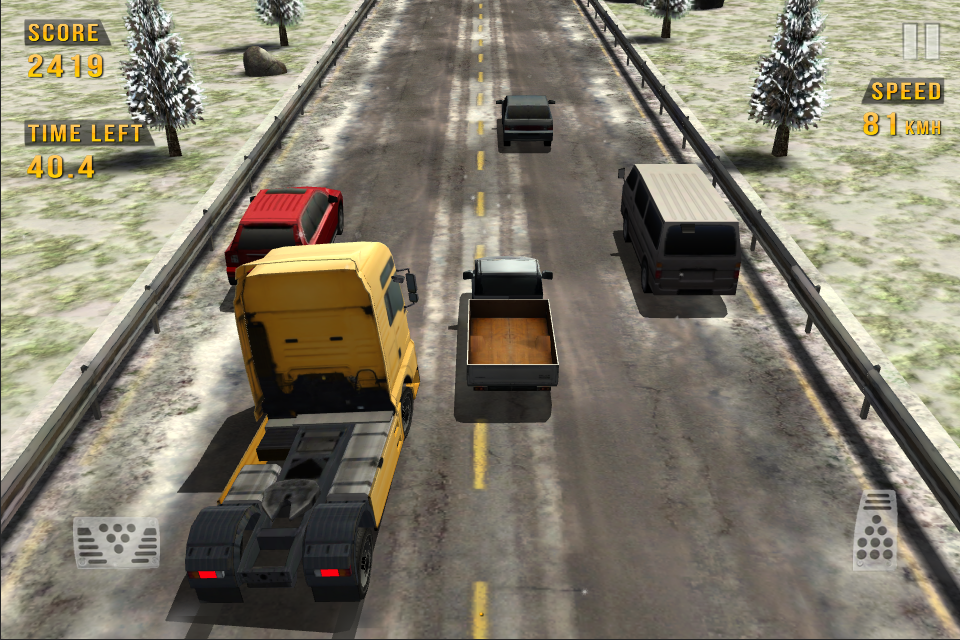
Traffic Racer is an endless arcade racing game that places players behind the wheel of various vehicles navigating dense highway traffic. The core gameplay loop centers on driving through endless traffic, earning cash rewards, and using those earnings to upgrade vehicles or purchase new ones from a roster of over 40 different cars.
The game's progression system ties directly to in-game currency accumulation. Players collect cash during each driving session, which serves as the primary means of advancing through the game's vehicle collection. This currency-based progression creates continuous motivation for repeated gameplay and exploration of different cars. The available vehicles span a wide range of styles and designs. Each can be customized with different paint colors and wheel options, allowing players to personalize their machines before taking them back to the highways for another run.
Traffic Racer features seven visually distinct environments that serve as the settings for driving: suburb, desert, snowy, rainy, forest, autumn, and city night. Each environment presents a different visual atmosphere and aesthetic, though the core driving mechanics remain consistent across all settings. The game renders these environments in 3D graphics, providing visual depth and environmental detail suited to each location.
The game contains four separate game modes that structure gameplay in different ways. Endless mode delivers the traditional experience of driving indefinitely through traffic with no time limit or specific completion objective. Two-Way mode introduces opposing traffic, adding complexity to the navigation challenge by placing vehicles traveling in both directions. Time Trial challenges players to complete objectives within a fixed time window, emphasizing speed and efficiency under pressure. Police Chase mode transforms the experience by introducing law enforcement pursuit mechanics into the gameplay, creating a variation on the core racing formula.
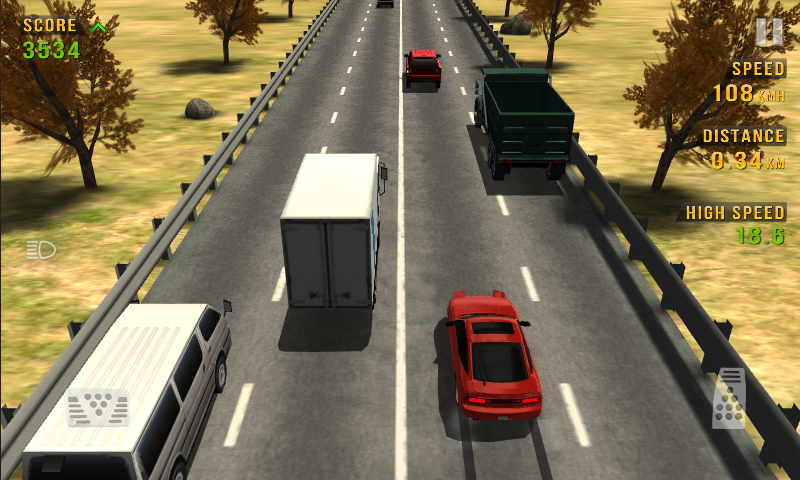
Traffic on the roads is populated with realistic vehicle types including trucks, buses, and SUVs. These vehicles create varying obstacles and traffic patterns that require players to adapt their driving and navigation strategies throughout each session.
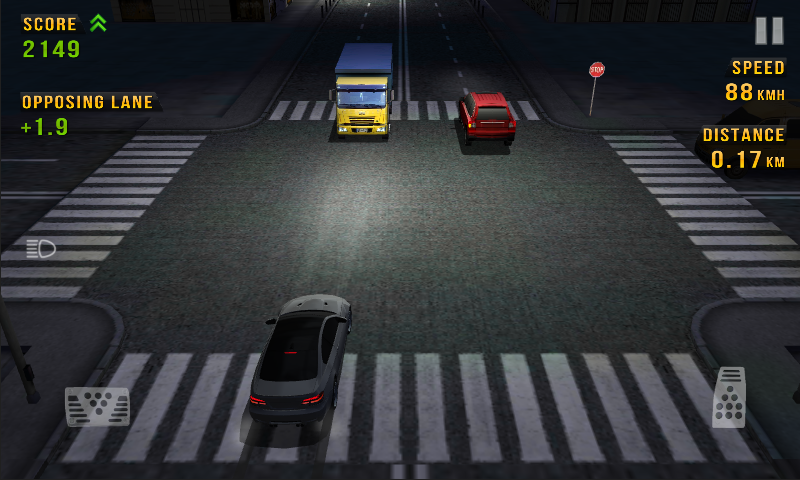
The scoring system incorporates speed-based mechanics that reward aggressive and skilled driving. Driving at higher speeds generates increased point totals, incentivizing players to maintain high speeds throughout their runs. Overtaking other vehicles while traveling above 100 kilometers per hour triggers bonus scores and cash rewards, creating a risk-reward dynamic in which players balance the danger of close-proximity maneuvers against potential score gains. In Two-Way mode specifically, driving against the normal traffic direction generates additional score and cash bonuses, fundamentally changing strategic approaches to that game mode.
Control options accommodate different input preferences and playstyles. Players can steer by tilting their device or using touch screen input. Acceleration and braking are controlled through dedicated touch buttons, giving players direct control over speed management. This layout keeps gameplay accessible while allowing skilled players to execute complex driving maneuvers and overtaking sequences at high speeds.
Online leaderboards display global performance rankings based on player scores, enabling competitive comparison with other drivers. An achievements system operates independently of vehicle progression, offering challenges and milestones that players can work toward separate from the primary economic loop, extending engagement beyond the core driving mechanics.
The game's progression system ties directly to in-game currency accumulation. Players collect cash during each driving session, which serves as the primary means of advancing through the game's vehicle collection. This currency-based progression creates continuous motivation for repeated gameplay and exploration of different cars. The available vehicles span a wide range of styles and designs. Each can be customized with different paint colors and wheel options, allowing players to personalize their machines before taking them back to the highways for another run.
Traffic Racer features seven visually distinct environments that serve as the settings for driving: suburb, desert, snowy, rainy, forest, autumn, and city night. Each environment presents a different visual atmosphere and aesthetic, though the core driving mechanics remain consistent across all settings. The game renders these environments in 3D graphics, providing visual depth and environmental detail suited to each location.
The game contains four separate game modes that structure gameplay in different ways. Endless mode delivers the traditional experience of driving indefinitely through traffic with no time limit or specific completion objective. Two-Way mode introduces opposing traffic, adding complexity to the navigation challenge by placing vehicles traveling in both directions. Time Trial challenges players to complete objectives within a fixed time window, emphasizing speed and efficiency under pressure. Police Chase mode transforms the experience by introducing law enforcement pursuit mechanics into the gameplay, creating a variation on the core racing formula.
Traffic on the roads is populated with realistic vehicle types including trucks, buses, and SUVs. These vehicles create varying obstacles and traffic patterns that require players to adapt their driving and navigation strategies throughout each session.
The scoring system incorporates speed-based mechanics that reward aggressive and skilled driving. Driving at higher speeds generates increased point totals, incentivizing players to maintain high speeds throughout their runs. Overtaking other vehicles while traveling above 100 kilometers per hour triggers bonus scores and cash rewards, creating a risk-reward dynamic in which players balance the danger of close-proximity maneuvers against potential score gains. In Two-Way mode specifically, driving against the normal traffic direction generates additional score and cash bonuses, fundamentally changing strategic approaches to that game mode.
Control options accommodate different input preferences and playstyles. Players can steer by tilting their device or using touch screen input. Acceleration and braking are controlled through dedicated touch buttons, giving players direct control over speed management. This layout keeps gameplay accessible while allowing skilled players to execute complex driving maneuvers and overtaking sequences at high speeds.
Online leaderboards display global performance rankings based on player scores, enabling competitive comparison with other drivers. An achievements system operates independently of vehicle progression, offering challenges and milestones that players can work toward separate from the primary economic loop, extending engagement beyond the core driving mechanics.
No reviews found!



No comments found for this product. Be the first to comment!