









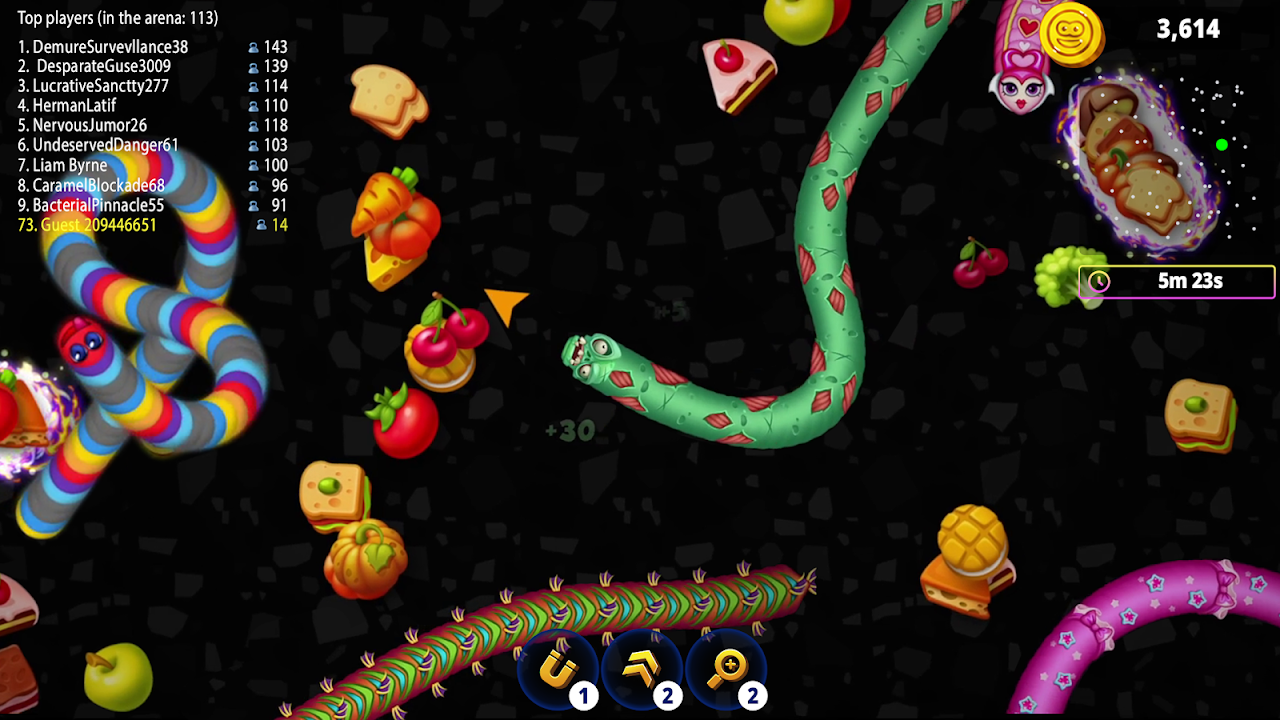
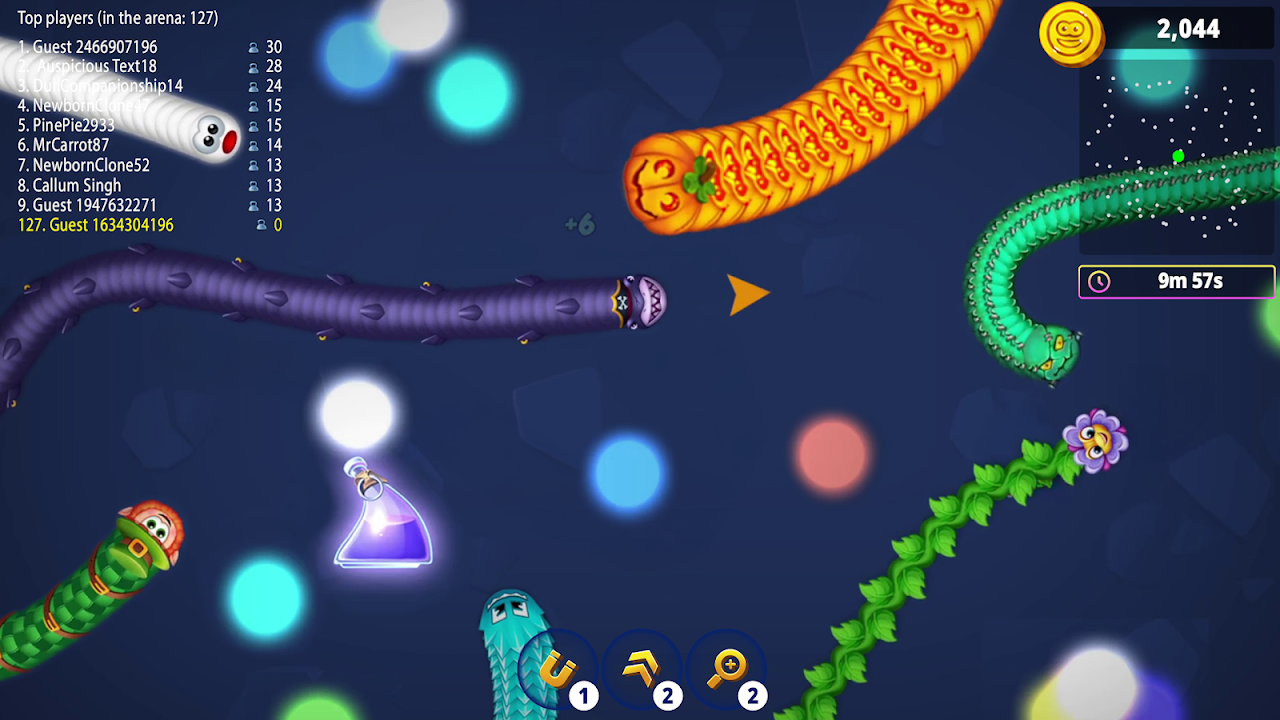
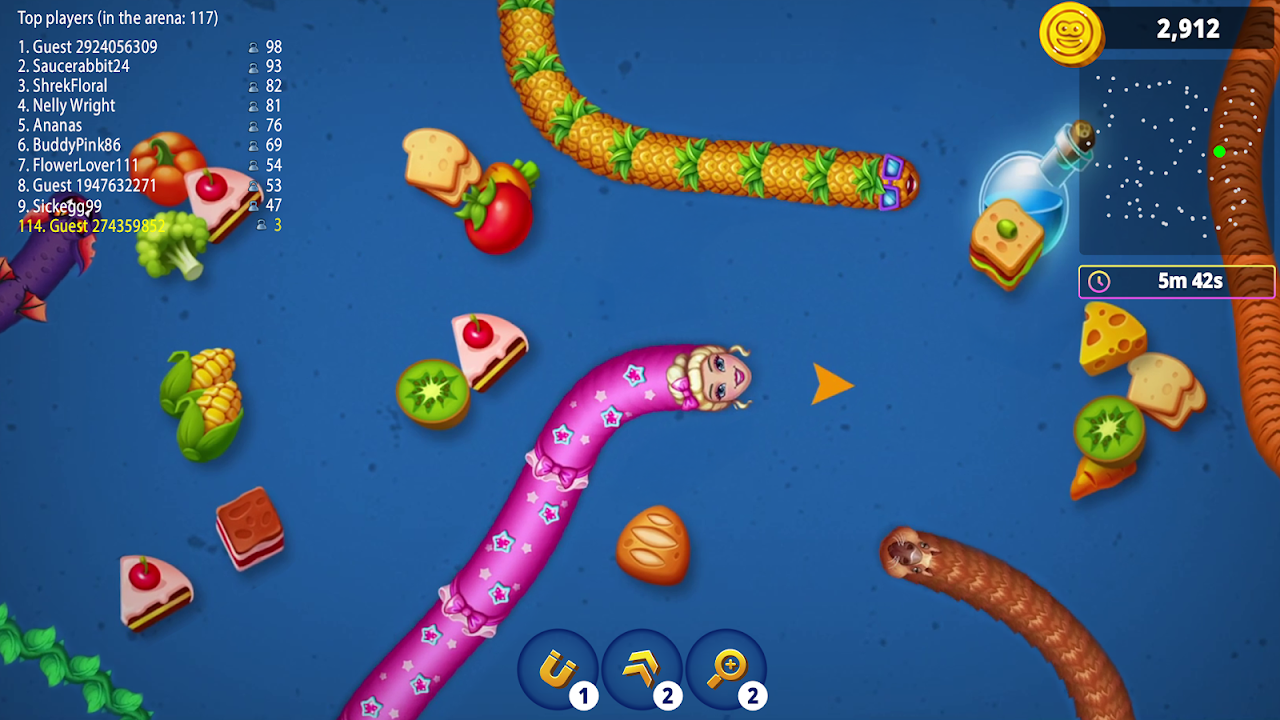
Worms Zone .io is a multiplayer arcade game where players control growing worms in real-time PvP competition. The core loop centers on expansion: worms consume scattered food items to increase in size while simultaneously competing against other players in shared arenas. The simple premise masks layers of tactical decision-making that develop as matches progress.
Food collection remains the primary progression mechanic. Each piece of food consumed adds to the worm's growth, making size a direct measure of advancement. However, size alone doesn't guarantee victory. When a worm collides with another player's worm, the colliding worm resets to a smaller state, losing accumulated progress. This collision mechanic creates constant tension—larger worms become targets, yet avoiding conflict limits growth opportunities.
The game introduces a territorial layer through encirclement. Players can circle other worms to trap and eliminate them, earning points while claiming the defeated worm's food. This mechanic shifts the dynamic from simple size accumulation to spatial awareness and positioning. A smaller worm with superior positioning can eliminate a larger opponent, rewarding strategic movement over brute progression.
Powerups scatter throughout arenas, providing temporary advantages or strategic options. These items introduce moments of volatility into matches, forcing players to weigh the risk of pursuing a powerup against their current position and nearby competitors. The availability and timing of powerups can determine match outcomes, creating opportunities for smaller worms to mount comebacks or dominant players to extend their advantage.
Three distinct tactical frameworks guide player approaches. The fighter strategy emphasizes aggressive collision play and direct confrontation. The trickster approach relies on positioning, outmaneuvering opponents through movement and spatial tricks. The builder style focuses on steady growth, careful food collection, and avoiding unnecessary risk. These frameworks mean the same game mechanics support vastly different playstyles, allowing players to develop their own rhythms rather than forcing convergence on a single optimal approach.
Customization extends to visual presentation through a wardrobe system. Players can equip worms with skins that alter their appearance in play. Skins unlock progressively through gameplay advancement, creating a progression pathway beyond raw match performance. This separation of cosmetic reward from competitive advantage means visual customization remains an incentive without affecting gameplay balance. Players accumulate different appearances as they log more playtime.
The visual presentation employs minimalist graphics. The stripped-down aesthetic prioritizes clarity and performance, ensuring players can track multiple moving worms and items without visual clutter. The simplicity also allows the game to run across a broad range of devices without extensive hardware demands, a practical advantage in real-time multiplayer competition where responsiveness and latency matter as much as visual fidelity.
The interaction between collision mechanics, encirclement possibilities, and tactical diversity creates layered gameplay decisions. A worm pursuing steady growth may accidentally trap a larger rival through natural movement patterns. A fighter-focused player might switch to trickster tactics mid-match when facing a superior opponent. The relatively finite resource pool of food and powerups in each arena means decisions ripple quickly through the match—one worm's growth limits food available to competitors, forcing constant adaptation and shifting the balance of power throughout the session.
Food collection remains the primary progression mechanic. Each piece of food consumed adds to the worm's growth, making size a direct measure of advancement. However, size alone doesn't guarantee victory. When a worm collides with another player's worm, the colliding worm resets to a smaller state, losing accumulated progress. This collision mechanic creates constant tension—larger worms become targets, yet avoiding conflict limits growth opportunities.
The game introduces a territorial layer through encirclement. Players can circle other worms to trap and eliminate them, earning points while claiming the defeated worm's food. This mechanic shifts the dynamic from simple size accumulation to spatial awareness and positioning. A smaller worm with superior positioning can eliminate a larger opponent, rewarding strategic movement over brute progression.
Powerups scatter throughout arenas, providing temporary advantages or strategic options. These items introduce moments of volatility into matches, forcing players to weigh the risk of pursuing a powerup against their current position and nearby competitors. The availability and timing of powerups can determine match outcomes, creating opportunities for smaller worms to mount comebacks or dominant players to extend their advantage.
Three distinct tactical frameworks guide player approaches. The fighter strategy emphasizes aggressive collision play and direct confrontation. The trickster approach relies on positioning, outmaneuvering opponents through movement and spatial tricks. The builder style focuses on steady growth, careful food collection, and avoiding unnecessary risk. These frameworks mean the same game mechanics support vastly different playstyles, allowing players to develop their own rhythms rather than forcing convergence on a single optimal approach.
Customization extends to visual presentation through a wardrobe system. Players can equip worms with skins that alter their appearance in play. Skins unlock progressively through gameplay advancement, creating a progression pathway beyond raw match performance. This separation of cosmetic reward from competitive advantage means visual customization remains an incentive without affecting gameplay balance. Players accumulate different appearances as they log more playtime.
The visual presentation employs minimalist graphics. The stripped-down aesthetic prioritizes clarity and performance, ensuring players can track multiple moving worms and items without visual clutter. The simplicity also allows the game to run across a broad range of devices without extensive hardware demands, a practical advantage in real-time multiplayer competition where responsiveness and latency matter as much as visual fidelity.
The interaction between collision mechanics, encirclement possibilities, and tactical diversity creates layered gameplay decisions. A worm pursuing steady growth may accidentally trap a larger rival through natural movement patterns. A fighter-focused player might switch to trickster tactics mid-match when facing a superior opponent. The relatively finite resource pool of food and powerups in each arena means decisions ripple quickly through the match—one worm's growth limits food available to competitors, forcing constant adaptation and shifting the balance of power throughout the session.
No reviews found!





No comments found for this product. Be the first to comment!